
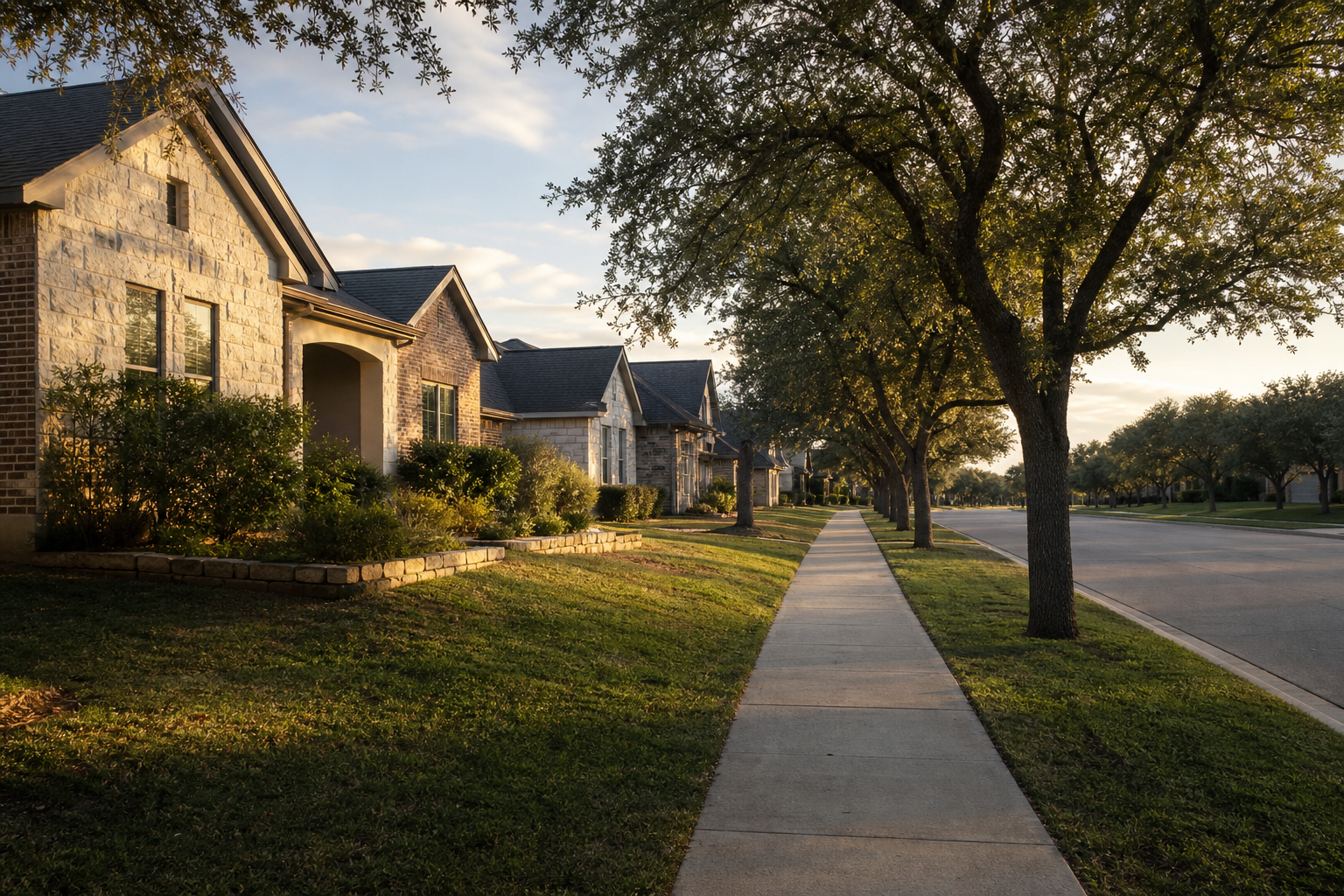
Round Rock’s rapid expansion creates affordability pressure that can push some buyers toward Killeen, but current Killeen-Temple data, 5.2 months of inventory and prices 4.57% lower year over year, shows regional growth is not yet lifting all Killeen values. Location, pricing, and buyer segment still drive individual outcomes.
Does Round Rock’s growth increase Killeen home values?
Round Rock’s expansion creates affordability pressure that can redirect some buyers toward Killeen, but the most recent Killeen-Temple data, 5.2 months of inventory, 110 days to sell, and a median listing price 4.57% lower year over year as of August 2026, shows that regional growth has not yet produced a broad lift in Killeen property values. The opportunity is real for certain homes and price points, but it is not automatic, and it depends heavily on pricing, presentation, and which buyer segment your property can realistically attract.
Key Takeaways
- The Killeen-Temple metro recorded a median listing price 4.57% lower year over year in August 2026, according to FRED, regional growth has not yet reversed that trend across the board.
- The July 2026 Killeen-Temple median of $270,841 sits well below the Austin-Round Rock-San Marcos median of $439,000, giving Killeen a real affordability story for price-sensitive buyers priced out of the corridor.
- Killeen-Temple had 5.2 months of inventory and 110 days to sell as of July 2026, meaning homes that are priced and presented well still compete, but overpriced listings sit.
- Round Rock reported $196.4 million in active roadway-improvement projects as of May 2026, a signal that the corridor’s infrastructure is expanding, which can gradually improve regional mobility and Killeen’s commute case.
- Which Killeen homes benefit most depends on proximity to Fort Cavazos, highway access, price band, and whether the property can attract buyers relocating from higher-cost markets, not on regional growth headlines alone.
What is actually happening in the Round Rock and Georgetown corridor?
Round Rock is not slowing down. The city estimated its population at 143,075 residents as of September 2026, and in May 2026 the mayor’s State of the City address highlighted $196.4 million in active roadway-improvement projects, work spanning Gattis School Road, Wyoming Springs Boulevard, Old Settlers Boulevard, and Chisholm Trail, among others. Georgetown is growing alongside it, with development pressure pushing north along the I-35 corridor.
That growth comes with a price tag for buyers. The Austin-Round Rock-San Marcos metro median sits around $439,000. When buyers get priced out of that market, or when remote-work flexibility gives them commute options they didn’t have before, some of them start looking north. That is where Killeen enters the picture.
The affordability math that matters for Killeen sellers
The July 2026 Killeen-Temple median of $270,841 is roughly $168,000 below the Austin-Round Rock corridor median. For a buyer who can tolerate the commute, or who works remotely, or whose employer is in the defense sector near Fort Cavazos, that gap is significant. Texas A&M’s Real Estate Research Center tracks housing activity for the Killeen-Temple market area, and the data confirms this is a meaningfully different price environment than what buyers face closer to Austin.
But I want to be direct with you: affordability alone does not make every Round Rock or Georgetown buyer a realistic Killeen buyer. Commute distance, employment location, lifestyle preferences, and transportation costs all filter that pool considerably. The buyers who end up in Killeen from the corridor tend to have a specific reason, a defense-related job, a remote-work arrangement, or a deliberate trade-off between price and proximity.
What the current Killeen-Temple market data actually says
Here is where I have to give you the honest picture, not the optimistic one. The FRED median listing price series for Killeen-Temple showed prices 4.57% lower year over year in August 2026. The same FRED data recorded 652 new listings in the metro in August 2026 alone. With 5.2 months of inventory and an average of 110 days to sell, this is not a seller’s market where regional tailwinds are doing the work for you.
That does not mean your home cannot sell well. It means that pricing right from day one is not optional, it is the difference between capturing a motivated buyer and watching your listing age on the market while better-priced homes move. I walk every seller I work with through a market analysis that accounts for their specific location, condition, and price band before we ever set a number.
| Market Indicator | Killeen-Temple (July/Aug 2026) | Austin-Round Rock-San Marcos |
|---|---|---|
| Median Sale/Listing Price | $270,841 | ~$439,000 |
| Months of Inventory | 5.2 months | Not directly compared |
| Average Days to Sell | 110 days | Not directly compared |
| Year-Over-Year Listing Price Change | -4.57% | Not directly compared |
| New Listings (August 2026) | 652 (metro) | Not directly compared |
Sources: FRED Killeen-Temple listing price series; FRED Killeen-Temple new listings series; Texas A&M Real Estate Research Center.
Which Killeen homes are best positioned to attract corridor buyers?
Not every property in the Killeen-Temple area draws from the same buyer pool. A home near Fort Cavazos competes primarily for military and defense-sector buyers, a demand channel that operates largely independent of Round Rock’s growth. A home in Harker Heights with easy highway access has a stronger case for attracting a price-sensitive buyer from the corridor than a home in a neighborhood with limited commute options.
The segments most likely to benefit from corridor-driven demand share a few characteristics: competitive pricing well below the Austin-area median, reasonable access to I-35 or US-190, and condition and presentation that hold up against the competition a relocating buyer would also consider. If your home checks those boxes, the affordability story is a genuine selling point. If it doesn’t, regional growth headlines won’t substitute for the fundamentals.
Your specific situation, location within Killeen, price point, condition, and timeline, determines whether corridor growth is a real factor in your sale or background noise. That is exactly the kind of question I work through with sellers before we build a listing strategy. For a deeper look at how strategic pricing fits into this picture, see my post on strategic pricing for Killeen and Harker Heights sellers.
Frequently Asked Questions
Is Round Rock growth pushing homebuyers toward more affordable Killeen?
It can, but the effect is selective. Buyers priced out of the Round Rock and Georgetown corridor, where the Austin-Round Rock-San Marcos metro median runs around $439,000, may consider Killeen’s $270,841 median a compelling alternative, particularly if they have remote-work flexibility or work in the defense sector near Fort Cavazos. Not every corridor buyer is a realistic Killeen buyer, though; commute distance and employment location filter the pool considerably.
How far is Killeen from Round Rock and Georgetown for commuters?
Killeen sits roughly 65-75 miles north of Round Rock and Georgetown via US-190 and I-35, translating to a commute of roughly 60-90 minutes depending on traffic and the specific destination. That distance works for buyers with flexible or remote schedules, but it is a real barrier for anyone who needs to be in the Austin core daily. The ongoing roadway investments in Round Rock, $196.4 million in active projects as of May 2026, may gradually improve regional mobility, but they do not eliminate the distance.
Does Killeen offer better value than Round Rock or Georgetown?
On a pure price-per-home basis, yes, the July 2026 Killeen-Temple median of $270,841 is roughly $168,000 below the Austin-Round Rock-San Marcos metro median. Whether that translates to better value for a specific buyer depends on their employment location, commute tolerance, and what they need from the surrounding area. For buyers whose work or lifestyle anchors them near Fort Cavazos or in Central Texas rather than Austin, Killeen can represent substantially more home for the money.
Are Killeen home prices likely to rise because Austin-area buyers are moving north?
The current data does not support that conclusion broadly. The Killeen-Temple metro showed a 4.57% year-over-year decline in median listing prices in August 2026, with 5.2 months of inventory and 110 days to sell, conditions that reflect a buyer-leaning market. Corridor-driven demand may support specific segments, particularly well-priced homes with strong highway access, but it has not produced a market-wide price lift. Sellers who price to the actual market rather than regional optimism will consistently outperform those who don’t.
How can I tell whether my Killeen home is benefiting from regional demand?
The clearest signals are where your showing requests originate, how quickly you receive offers relative to comparable listings, and whether buyers mention affordability or relocation from a higher-cost market as a motivation. A local market analysis that looks at recent sales in your specific neighborhood, price band, and proximity to Fort Cavazos or major corridors will give you a much sharper picture than metro-level averages. That analysis is the first thing I put together for any seller I work with, it is the only way to know whether regional tailwinds are actually working in your favor.
The Round Rock and Georgetown corridor’s growth is real, and the affordability gap between those markets and Killeen is a legitimate part of your home’s story, but it is one chapter, not the whole book. The sellers who do best right now are the ones who pair that regional narrative with precise pricing, strong presentation, and a clear-eyed read on their actual competition. If you want to know exactly where your home stands in this market, I’ve put together a deeper breakdown of how corridor growth affects Killeen-Temple sellers specifically, and I’m always glad to walk through your property’s position directly.
Ready to find out what your Killeen home is actually worth in this market? Schedule a no-obligation consultation here.
Equal Housing Opportunity. Stephen Harris is a Texas Associate Broker with the Good Life Team at All City Real Estate, Ltd. Co., licensed by the Texas Real Estate Commission. This article is general market information only, not legal, tax, or financial advice. Confirm your own numbers with your title company, tax advisor, or lender before making any transaction decision.
Leave a Reply